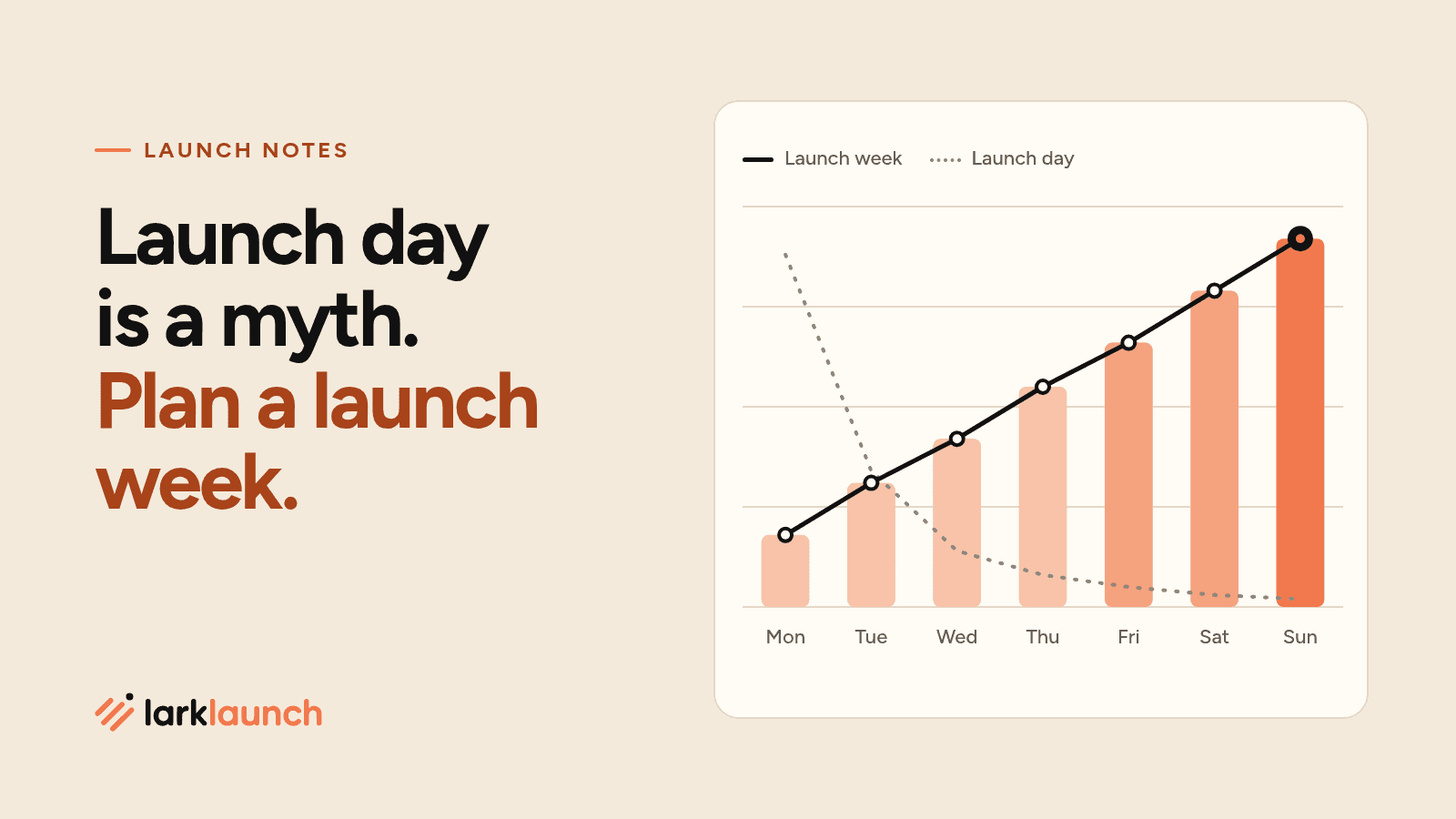
You spend six weeks building, two weeks polishing the landing page, and one evening writing the launch post. Then the launch happens, and by the time you have answered the first round of comments it is mostly over. The traffic graph looks like a cliff with a long, flat floor.
That shape is not bad luck. It is what you get when the whole plan fits inside a single day. If your post goes up at the wrong hour for your audience, or a bigger product launches the same morning, there is no second chance. Everything rides on a window you do not control.
On LarkLaunch, a launch runs for a full week, from Monday 00:00 to Sunday 23:59 UTC, and the ranking only settles when the week closes. We built it that way because a week gives a small team room to do the things that actually win users: talk to people, fix what they report, and show up again tomorrow. The plan below is built around that week, but it works wherever you launch.
It is written for founders with no budget and no audience. Every step costs time, not money, and each day has one task that matters most. If a day goes badly, do that one task and move on.
The week at a glance
| Day | Focus | The one task that matters | Watch |
|---|---|---|---|
| Before | Get ready | Write the list of 30 people you will message by name | Your list is done |
| Monday | Open | Post your maker comment and send the first personal messages | Replies to your messages |
| Tuesday | Listen | Reply to every comment and ship one fix someone asked for | Comments answered |
| Wednesday | Tell the story | Publish one honest post about how you built it | New visitors from the post |
| Thursday | Spread | Submit to five directories that send real traffic | Submissions sent |
| Friday | Ask | Ask three happy users for a sentence you can quote | Quotes collected |
| Weekend | Finish | Post a recap and thank everyone who helped | Signups for the week |
The “Watch” column is deliberately not upvotes. Votes follow from the work in the third column. Track the work and the votes take care of themselves.
Two weeks before: get launch-ready
A launch does not create interest. It concentrates attention for a few days, and the product has to convert that attention on its own. Spend the two weeks before on the parts people see in the first ten seconds, and on the people you will ask for help.
Make the product easy to say yes to
- A tagline that names the person and the change. “Invoices for freelance designers that get paid in half the time” beats “The future of invoicing.” A good test: if a stranger cannot repeat it back after one read, rewrite it. A simple shape that works is [what it is] for [who] that [result they care about].
- Three screenshots and a short video. The first screenshot is your real headline, because most people never read the description. Show the product doing its main job, not the settings page. Keep the video under a minute, start it on the result, and make sure it makes sense with the sound off.
- A way in without a sales call. A free tier, a trial without a card or a live demo account. People upvote what they can try in two minutes, and they comment on what they have actually used.
- A first run that works. Sign up as a new user on a phone and on a laptop. Time how long it takes to reach the moment the product is useful. Whatever slows that down is your most important fix this fortnight.
- Pricing people can find. “How much is it?” is the most common launch comment. Answer it on the site before anyone has to ask.
Get the people and the words ready
- A list of 30 people, by name. Past colleagues, early users, the friend who keeps asking how the project is going, people who replied to your posts while you were building. Not a mailing list. You will write to each of them yourself.
- Your maker comment, drafted. Why you built it, who it is for, what is still rough and the one piece of feedback you want most. Honest beats polished here. There is a template further down.
- Answers to the five questions you will get. How is it different from the obvious competitor, what does it cost, where is the data stored, is there an API, what is next. Write a short answer to each so Monday is replies, not research.
- A small launch kit. Your logo, two screenshots sized for social posts, the tagline, a two-sentence description and the launch link, all in one folder. Anyone who offers to share should get it in one message.
Make the week measurable
- Know where signups come from. Add a “Where did you hear about us?” field to sign-up, or use tagged links (for example
?ref=larklaunch) for each place you share. You will want this on Sunday. - Write down today's numbers. Weekly visitors, signups and active users before the launch. Without a baseline you cannot tell what the week actually did.
Pick your week
Every LarkLaunch week holds a limited number of launches. When you submit, your launch takes a spot in the current week if there is room, or in the first week after that has one, and it waits for a quick review by hand. Once approved, it goes live straight away if its week is already running, or at 00:00 UTC on that week's Monday.
That leads to a few practical rules:
- Want all seven days? Submit before the week starts. A launch approved on a Thursday still gets the weekend, but it competes with products that have had three extra days of votes.
- Submit when you are ready, not when you are done. You get a confirmation that shows which week you landed in, so you can plan your two weeks of preparation around a real date.
- Avoid weeks you cannot show up for. Holidays, a conference you are speaking at, a big client deadline. The plan below needs about an hour a day, every day.
- Look at the current leaderboard. Seeing what launched recently tells you what the audience responds to and how your listing will look next to it.
Monday: open with the people who already know you
Go live early in the day and post your maker comment straight away, so the first visitors see a person behind the product rather than an empty discussion. Then share the launch link once on each channel you use, with one line on what is new.
Then work through your list. Write each message by hand and ask for something specific: “Could you try the import and tell me the first thing that confused you?” gets far better replies than “Please upvote.” Many of those people will vote anyway, and the ones who reply give you Tuesday's material.
Early votes matter on any ranked list because they decide who sees you next. Getting your first ten from people who genuinely care is the most reliable way to earn the next hundred from people who don't know you yet.
Tuesday: answer everything, then fix something
Reply to every comment within a few hours, including the critical ones. A thoughtful answer to “how is this different from X?” does more for the next reader than anything on your landing page, because it shows how you think.
Pick the most common complaint from Monday and fix it today if you can. Then say so in the thread: “Shipped a fix for the CSV bug Maya reported this morning.” Nothing builds trust faster than watching a founder respond in hours, and it gives people a reason to come back to the page.
Critical comments deserve the most care. Thank the person, agree with whatever is true, explain what you will do and when. Never argue in public. Readers judge the product by how you handle the worst comment, not the best one.
Wednesday: tell the story nobody else can
By midweek the first wave has passed, so you need a new reason for people to look. Write one post about how the product came to exist, and put a real detail in it: what it cost to run, the feature you threw away, the month nobody signed up. Specifics travel. Generic announcements do not.
Share it where your users already spend time, whether that is X, LinkedIn, Indie Hackers, Reddit or a niche forum. Each place has its own rules, and many communities do not allow plain promotion, so lead with the story and the lesson and put the link at the end. Link to your launch page rather than your homepage, so new readers land on the discussion and see other people already using the product.
You can post the same update to the LarkLaunch feed, where other founders follow what people are building and often reply with their own experience.
Thursday: submit to directories that send traffic
Directories are slow, steady traffic and useful backlinks, but only if you choose them well. A long list of dead sites is worth less than five good ones. Look for real monthly visitors, a dofollow link if you care about search, and an audience that matches yours.
Our list of launch directories shows domain rating, traffic, price and link type for each, so you can filter down to the free, dofollow options in a minute. Reuse your copy, but rewrite the first line for each site's audience, and spread submissions across a few days so reviewers are not all reading the same paragraph at once.
Keep a simple sheet with the site, the date you submitted, the login you used and the live link once it appears. Many directories take weeks to publish, and you will not remember where you applied.
Friday: ask for proof
By now some people have used the product for a few days. Write to the three who seem happiest and ask for one or two sentences you can quote, with their name and role. Put the best one near the top of your site the same day.
It is also a good day to publish a short changelog of the week. A list of five small fixes, each credited to the person who asked, tells new visitors the product is alive and the founder is listening.
The weekend: keep going while others stop
Plenty of founders treat Friday as the end. On a weekly leaderboard, Saturday and Sunday votes count exactly as much as Monday's, and the page is quieter, so each one moves you further.
Post a short recap: what you launched, what people asked for, what you changed and what is next. Reply to late comments. On Sunday evening, thank the people who helped, by name where they are happy to be named.
If the launch goes quiet
Most launches stall at some point, usually on Tuesday or Wednesday. That is normal and it is fixable. Before you do anything, find out which kind of quiet it is.
- Nobody is visiting. The problem is reach, not the product. Go back to your list and send ten more personal messages, then publish Wednesday's story early.
- People visit but do not click through. The listing is not making the case. Rewrite the tagline, swap the first screenshot for one that shows the result, and add a comment that answers the question people keep asking.
- People click through but do not sign up. The landing page or first run is losing them. Check it on a phone, cut a step out of sign-up, and make the free way in more obvious.
- People sign up but do not come back. That is the most valuable thing you will learn all week. Email five of them and ask what they expected to happen.
Read your numbers
Your LarkLaunch analytics show page views, unique visitors, clicks through to your website and where visitors came from, day by day. Combined with your own signup numbers, they tell you where the funnel leaks.
| What you see | What it usually means | What to try |
|---|---|---|
| Few views | Not enough people know it is live | More personal messages, one more channel, a story post |
| Views, few website clicks | The listing does not make people curious | Sharper tagline, a first screenshot that shows the result |
| Clicks, few signups | The landing page or sign-up loses them | Test on a phone, shorten sign-up, show pricing clearly |
| Signups, no second visit | The first run does not reach the useful moment | Ask five new users what they expected, fix the first step |
| One source sends most visits | You found a channel that fits | Go back there with Friday's quotes or the changelog |
Copy-ready templates
Rewrite these in your own voice. They are a starting shape, not a script.
The maker comment
Hi everyone, I'm [name], and I built [product].

I made it because [the specific problem you had, in one or two sentences].

It's for [who], and it helps them [the result] without [the usual pain].

What works today: [two or three things].
What's still rough: [one honest thing].

The feedback I'd value most: [one specific question].

Free to try at [link], no card needed. I'll be here all week answering questions.
The personal message
Hey [name], I finally launched [product] today. It's the [one-line description] I mentioned back in [when/where].

Would you try [one specific feature] and tell me the first thing that confused you? Takes about two minutes: [launch link]

No pressure at all, and thanks either way.
The weekend recap
A week ago I launched [product]. Here's what happened:

- [number] people tried it, [number] signed up
- The most requested thing was [request], and it shipped on [day]
- The best feedback came from [person/role]: "[short quote]"
- The thing I got wrong: [one honest lesson]

Next up: [what you're building next].

Thank you to everyone who tried it, commented or shared it. Especially [names].
The 30 days after
The launch week ends on Sunday. What it started does not have to.
- Week 1: email everyone who signed up during the launch, personally if you can. They arrived curious, and a note a week later converts well. Ask one question and read every reply.
- Week 2: link to your week on the past leaderboards page from your site and changelog, and add the quotes from Friday to your landing page.
- Week 3: write down what brought people in, using the sources in your analytics and the “where did you hear about us” answers. That list is the start of your next launch.
- Week 4: check which directories have published your listing and follow up on the ones that have not.
Then plan the next one. A big new feature, a new integration or a free tool can each carry their own launch week. Founders who launch every few months build an audience that the first launch never could.
What not to do
- Don't buy votes or join vote rings. They are easy to spot, they get launches removed, and the people they bring never become users.
- Don't mass message strangers. A copied “upvote pls” in fifty inboxes costs you more goodwill than it earns.
- Don't launch a waitlist. If people cannot try anything, they have nothing to vote for or talk about. Launch when someone can get value on the first visit.
- Don't disappear after Monday. An unanswered comment on day three tells every later visitor the product might be abandoned.
- Don't change everything at once. If the week is slow, change one thing, the tagline or the first screenshot, and watch the numbers for a day before changing the next.
The full checklist
Two weeks before
- Tagline names the person and the result
- Three screenshots and a video under a minute
- Free tier, trial or demo with no sales call
- Sign-up tested on a phone
- Pricing visible on the site
- List of 30 people, by name
- Maker comment drafted
- Answers to the five common questions
- Launch kit folder ready
- Baseline numbers written down
- Launch submitted and week confirmed
During the week
- Monday: maker comment posted, first messages sent
- Tuesday: every comment answered, one fix shipped
- Wednesday: story post published
- Thursday: five directories submitted
- Friday: three quotes asked for, changelog posted
- Weekend: recap posted, helpers thanked
After
- Email to every new signup
- Leaderboard week linked from your site
- Sources of signups written down
- Next launch on the calendar
Questions founders ask
Can I launch on other sites in the same week?
Yes, but stagger them. Spreading launches across the week gives you a new reason to share every couple of days, and you are not answering comments in four places at once on Monday morning.
Should I launch before I have any users?
Launch once a stranger can get value on the first visit. You do not need users first, but you do need a product that works without you on a call.
How many votes do I need to do well?
There is no fixed number, because every week is different. Focus on the daily task. A launch with fifty thoughtful comments and a handful of loyal users is worth more than a high rank with nobody signing up.
What if I miss Monday?
Start from wherever you are. Do Monday's task first, then carry on with the plan. The weekend counts as much as the start of the week.
Is paying for placement worth it?
Only once the basics above are done. Paid placement brings more eyes to the listing, but it cannot fix a tagline that does not land or a sign-up that loses people. Get the free version of the week working first. If you then want more reach, the pricing page lists what is available.
Ready for your week?
Launching on LarkLaunch is free. Every product is reviewed by hand and gets a full Monday to Sunday week on the leaderboard, plus a permanent listing with a dofollow link.
Launch your product