Most products that fail were built well. They fail because nobody wanted them badly enough to switch, and the founder found out after six months of building instead of after one week of asking.
You can find out much sooner. Not with certainty, because nothing gives you that, but well enough to know whether the idea deserves the next three months of your evenings. This guide is a seven-day plan to do it with no budget, no audience and no code. By the end of the week you will have spoken to real customers, watched strangers react to your pitch, and asked a few of them for money.
Every step is cheap. The hard part is emotional: you have to go looking for reasons your idea is wrong. Founders who do that early build the right thing sooner.
What validation actually means
An idea is validated when people give up something they value to get it: money, time, or their reputation. Compliments do not count. Neither do likes, waitlist sign-ups from friends, or a survey where people say they “would definitely use” it. People are kind, and saying yes to a hypothetical costs them nothing.
So the week is built around three questions, in this order:
- Is the problem real and painful for a specific group of people, painful enough that they already spend time or money on it?
- Is your way of solving it clearly better than what they do today, by their measure rather than yours?
- Will they pay, or commit something real, before the product exists?
If the answer to the first question is no, the other two do not matter. That is why it comes first.
The week at a glance
| Day | Goal | What you do | Done when |
|---|---|---|---|
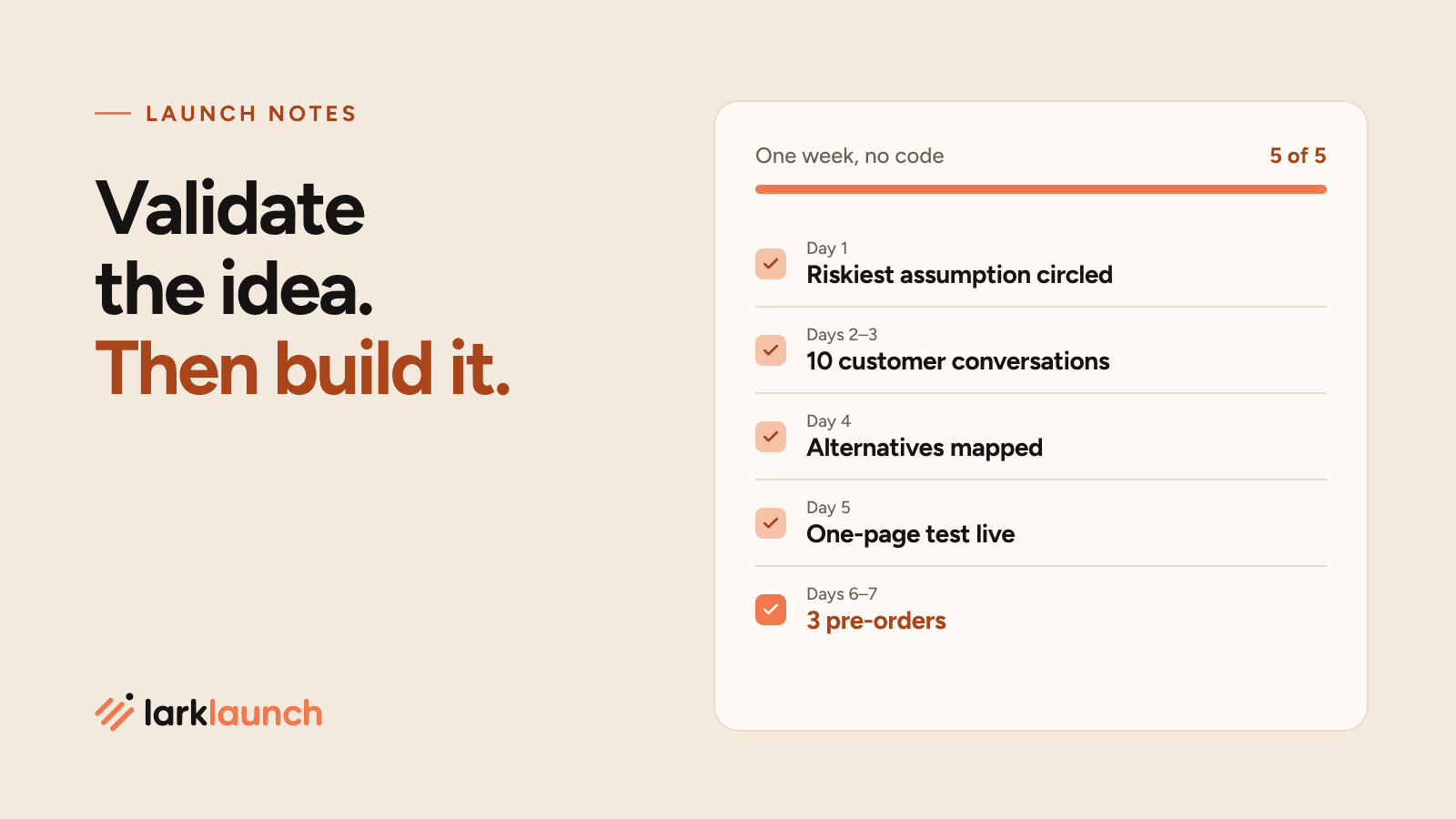
| 1 | Assumptions | Write down what must be true, and find the riskiest part | One assumption is circled |
| 2–3 | Problem | Ten short conversations with people who have the problem | Ten calls held, notes written |
| 4 | Competition | List what they use today and why it falls short | A table of alternatives |
| 5 | Message | A one-page site with a clear offer and a sign-up | The page is live and shared |
| 6–7 | Payment | Ask the most interested people to pre-order or commit | Asks sent, answers counted |
Day 1: write down what has to be true
Every idea rests on a stack of guesses. Write yours down as plain sentences, using the shape [this kind of person] has [this problem] often enough to [pay or switch]. For an invoicing tool for freelance designers, the list might be:
- Freelance designers are regularly paid late, more than once a month.
- Chasing payments is awkward enough that they put it off.
- They would let software send reminders in their name.
- They would pay $10 a month for it instead of using a free invoice template.
Now circle the one that, if wrong, kills the idea, and that you are least sure about. That is your riskiest assumption, and the rest of the week exists to test it. Usually it is the last one: people having the problem is common, people paying to fix it is not.
If you want a second opinion before you start, run the idea through our free startup idea validator. It points out the weakest assumption and suggests three experiments for the week. Treat it as a sparring partner, not a verdict: only customers can validate an idea.
Days 2 and 3: talk to ten people
Find ten people who match your customer and ask for fifteen minutes. Look where they already gather: subreddits and Slack groups for their trade, LinkedIn, people who left reviews of a competitor, or friends of friends. A short, honest message works better than a clever one (there is a script below).
In the conversation, do not pitch. Ask about the last time the problem happened, and keep asking what happened next. Past behaviour is evidence; opinions about the future are not.
Questions that get honest answers
- “Tell me about the last time [the problem] happened. What did you do?”
- “How often does that come up?”
- “What have you tried to fix it? What did that cost you?”
- “What is the most annoying part?”
- “If you could wave a wand, what would happen instead?”
Questions to avoid
- “Would you use an app that…?” Everyone says yes.
- “How much would you pay?” People guess low or high to be polite.
- “Do you think this is a good idea?” They will protect your feelings.
Day 4: map what they use today
Your real competitor is rarely another startup. It is a spreadsheet, a habit, an agency, or doing nothing. Using your notes, list every alternative people mentioned, and for each one write what it costs them and why they put up with it.
Then search for products that already do what you plan to do. Finding some is good news: it proves people pay for this. What you need is a clear reason a specific group would switch: cheaper, much simpler, made for their niche, or solving the part the others ignore. If you cannot say that reason in one sentence, keep narrowing the customer until you can.
Day 5: put up a one-page test
Build a single page that says who it is for, the outcome they get, and what it will cost, with one button: “Get early access” or “Pre-order”. Use the words your interviewees used to describe the problem; they convert better than yours. A no-code builder is plenty.
Before you share it, check the page title and preview look right in search results and when the link is pasted into a chat. Our meta tag generator shows both, and the UTM builder tags each link so you know which post sent each visitor.
Share it where your customers are, and send it to everyone you interviewed. Measure the share of visitors who sign up, not the number of visitors.
Days 6 and 7: ask for money
Go back to the people who were most interested and ask them to commit something real: a pre-order at a discount, a paid pilot, a deposit, or at the very least a scheduled call to set it up for them. Asking for money feels uncomfortable. Do it anyway; it is the only question in this whole week that cannot be answered politely.
Some will say no. Ask why, and listen carefully: “not right now” and “it doesn’t do X” are very different answers. Two or three people paying before the product exists is a strong signal for a small business. Zero out of ten tells you to change the customer, the problem or the offer before writing code.
Score the week
Count, do not guess. Here is a rough guide to reading the numbers from ten conversations and one landing page:
| Signal | Weak | Promising | Strong |
|---|---|---|---|
| Interviewees who already tried to fix it | 0–2 | 3–5 | 6+ |
| Landing page visitors who sign up | Under 5% | 5–15% | Over 15% |
| People who pre-order or commit | 0 | 1–2 | 3+ |
| People who introduce you to someone else | 0 | 1–2 | 3+ |
These are rules of thumb for a niche B2B or prosumer product, not laws. Compare weeks with each other: a second test that beats the first tells you that you are getting closer.
Copy-ready scripts
Rewrite these in your own voice. They are a starting shape, not a script to read out.
Asking for a conversation
Hi [name], I'm researching how [type of person] deal with [problem], and I saw your [post/review/comment] about it.

I'm not selling anything. Could I ask you a few questions about how you handle it today? 15 minutes, whenever suits you.

Thanks either way.
Asking for a pre-order
Thanks again for talking me through [problem] last week. Based on what you and others told me, I'm building [one-line description].

The first version will [the one result they cared about]. It'll be [price] a month, and early customers get [discount] for the first year.

Would you like to pre-order? If it doesn't ship by [date] or it isn't what you needed, I'll refund you in full.
Mistakes that fake a yes
- Talking only to friends. They want you to succeed. Ask strangers who match the customer.
- Pitching instead of listening. Once you describe your solution, people start reviewing it instead of telling you about their problem.
- Counting interest as demand. “Let me know when it launches” is a polite exit, not a customer.
- A customer that is too broad. “Small businesses” is everyone and no one. Pick a group you can list by name.
- Changing the idea every day. Run the week, then decide. Moving the target mid-week leaves you with no clear answer.
The checklist
Learn
- Assumptions written as sentences
- Riskiest assumption circled
- Ten conversations held, not pitched
- Notes on what each person did last time
- Table of alternatives and what they cost
Test
- One-page site with price and one button
- Page title and link preview checked
- Tagged links shared where customers are
- Pre-order asked of the most interested
- Results counted against the scorecard
Questions founders ask
What if someone steals my idea?
Almost nobody wants to. Ideas are cheap; the work of building and selling is not. The risk of talking to too few people is much bigger than the risk of being copied.
Is a week really enough?
It is enough to know whether to keep going. It is not enough to know whether you will build a big company. Treat it as the first of several cheap tests, each a little closer to the real product.
Should I build an MVP instead?
Build once you have a reason to: people who pre-ordered, or a clear pattern from your conversations. Then build the smallest thing that delivers the one result they cared about, and launch it to real users as soon as it works.
What if every test comes back weak?
That is a good week, not a failed one: you saved months. Look at your notes for a narrower group with a sharper version of the problem, and run the week again on them.
Got your first yes?
When the first version works, launch it on LarkLaunch. It is free, every product is reviewed by hand, and a full Monday to Sunday week on the leaderboard puts it in front of founders and early adopters who will tell you what to fix next.
Launch your product